Showing posts with label how to. Show all posts

Friday, July 13, 2012

How to Mark Butter

I've gotten in the habit of marking my sticks of butter by tablespoon. Before I did that, I kept the butter paper so I would have its markings. But the paper would get messy, and it was a less than ideal solution. So, this is what I do now. It works for me, and maybe it will work for you. Start with your butter still in its paper, and a clean knife you pulled from the drawer.

Using the dull side of the knife, gently press on each tablespoon marking, rolling it a little to indent the butter beneath.


Unwrap your butter, and voila! Each tablespoon of butter is marked out nicely for you!

Place in your butter dish (sans paper), and you're ready to bake! Mmmm...butter....

Monday, April 16, 2012

How to Build a Rain Barrel

The Problem:
A garden, which requires daily watering in the summer.

A gutter that creates a waterfall to the ground, and the water has gouged an 8-inch hole in the ground.

The Solution:
A rain barrel! A rain barrel will catch the falling water, and save it for when we need it.


We looked around to buy a barrel, but they're fairly expensive. We really had no idea how large a barrel we needed. We checked out YouTube for videos of how to make one ourselves. It turns out that it was a project that was fairly inexpensive and simple, so off we went to Home Depot.

Supplies:
  • Irrigation tube: $5.41
  • 32 gal. trash can: $9.88
  • 3/4" spigot: $5.33
  • Auto/Marine sealant: $4.57
  • 8 cement blocks: $$1.39 each, $11.12 total
  • 4 cement caps: $1.09 each, $4.36 total
  • 2 1" Spring Clamps: $2.09 each, $4.18 total
  • Things around the house: Knife, scissors, x-acto knife, Sharpie, length of old water hose, dirt
Total Price: $44.85
Let's get started!

The Base:
  1. Arrange four cement blocks in a square, leaving a square hole in the middle (see the photos below)
  2. We filled the spaces with dirt for extra stability
  3. Start with the next layer of cement blocks. Fill with dirt.
  4. Top off with the cement caps
Tada!

The Spigot:
  1. Trace around the spigot onto the side of the trash can. Cut out inside the traced hole.
  2. Apply glue
  3. More glue
  4. Work the spigot into the hole
Tada!

The Overflow Hose:
  1. Trace around the hose and cut a hole a few inches from the top of the trash can.
  2. Cut the hose to length long enough to send the overflow water where you want it (Ours was just long enough to make it to the ground and a foot or so away. We already had the water pounding into the ground, so a softer flow of water onto the same place seemed like it would be fine. You could use a longer hose to direct to a flower bed or wherever.)
  3. Insert the hose into the cut hole. Make sure the metal attachment is on the inside of the trash can, to help the hose stay in place
  4. Glue

The Drain Pipe:
  1. Cut slits in the rim to accommodate the larger gutter.
  2. Slide over gutter and measure length to trash can.
  3. Cut off excess pipe
  4. Trace and cut hole in trash can lid 
  5. Clamp pipe to gutter, and put other end of pipe in trash can
Tada! You're done! Now just wait for the rain! It only took one night of good rain to fill up our barrel! I'll be interested to see how much water it takes to water the garden.

Notes:
  1. If you're an observant kind of person, you'll notice that in the pictures, our rain barrel moved from directly under the window to a few feet to the right. Let's just say, test out your pipe and how it connects to the gutter before deciding where to put the base.
  2. I suppose, if 32gal doesn't end up being enough, that we could add a second barrel using the same technique, only connecting it to the first barrel with the overflow hose, so it will fill up after the first is full.
  3. I'm hoping that having a lid for the barrel will prevent mosquitoes, but I will definitely be checking occasionally. A friend suggesting adding Mosquito Dunkers to the water to prevent mosquitoes. They're donut-shaped things that float on the water and kill mosquito larva.
After last night's rain, it looks like we'll need to add a little more sealant around the spigot. Other than that, I'm completely satisfied with my new rain barrel. I can't wait to start using it, and I really hopes it helps with our water usage this summer! 

Wednesday, March 14, 2012

How to Cut an Angled Bob Haircut

Now you have cut your bangs all by yourself...how about giving yourself an entire haircut?

I've cut my hair for almost ten years now. That has included long hair, pixie cuts, and everything in between. Some haircuts have been huge fails, but you know what? I've paid for haircuts that have been huge fails before, too, so it happens to the best of us, I guess. While I've had stints in this time where I've paid for my haircuts, these days I mainly stick to cutting my hair myself. I can make the decision for the cut at the spur of the moment, I don't have to make an appointment, and I don't have to make sure someone else can watch the boys. It's free, and if it goes horribly wrong, I can always go the salon if needed.

So, not to say you need to give up your weekly/monthly/bimonthly appointment, but if you're interested in trying out a haircut on yourself, here's a good one to try. The Angled (or Wedged) Bob haircut. It's like a bob, only it angles up at the back.

Start with wet hair and pull it straight back into a tight pony tail. The higher your pony tail, the more layers you will have.


Pull the pony tail out away from your head to desired length. (If you want a very short wedge, and don't pull it out at all, this method will probably not work for you. It will cut too much off.)

Now cut off all the hair beyond the pony tail! Exciting!

Pull the holder out and admire your work so far. The hair at the back of my neck is usually a bit thick, so I hold the hair in my fingers (which are perpendicular to the ground) and trim. This would have been a good time for a picture, but it didn't happen.


It's almost right, but I've found that it helps to then cut off another inch or so straight off the bottom. I'm grabbing my chip clip from when I clipped my bangs to do this task. Clip and cut!

The chip clip wouldn't hold some of the hair up front, so I just pull that down with my fingers and snip it off.

Here it is air dried. Crazy hair and all it's flippy-ness.

And now I've told it who's boss. The flat-iron, THAT's who's boss!

From the side (that chunk of hair over my right shoulder is a reflection in the mirror, NOT an overlook on my part!).

You can see at the nape of my neck where the hair is still a bit thick and could use a little more trimming, but I've got to head out, so this is what it is for today. I can mess with it later, or just let it grow out a bit and no one will notice. *wink*

Obviously you can personalize this to your own taste! Leave it longer in front where I decided to cut it. Pull the ponytail higher for more layers in the back, or lower for less. Or, for an overall layered look with no angle, pull the hair up directly on top of your head! That's how my mom did it in college, which is where I got the idea in the first place to try it with an angle.

Have fun with it, and let me know if you try it!

Sunday, March 11, 2012

How to Cut Bangs

Cutting bangs has always been a bit of a hassle to me. And considering I keep my bangs pretty long, I have to cut them often to keep them out of my eyes. A while back I saw an interesting idea about cutting hair using a special tool that looked a lot like a chip clip, and I thought it would be perfect for bangs! So...here it is! How to cut your bangs with a Pampered Chef chip clip.

The before:

Tools Needed: comb, sharp scissors, and a swing-arm chip clip (Pampered Chef was the first place I saw this kind, but they're at Kroger and other places now)

 Use the comb to section off the hair you want to cut. I sort of part mine in a wedge (think of the opposite of a widow's peak). Then clip your bangs with the chip clip. Slide the clip down the hair to the desired length. Clip with scissors.

Tada!

Sunday, October 31, 2010

How to Give Yourself a French Pedicure

The state of my toenails is a good indicator about the state of my life.

A beautifully pedicured pair of feet means that I've had time to stop and take care of myself. Most times my feet sport the slapped-on, make-do bit of polish that covers the flaking polish from the last real, sit-down-and-enjoy pedicure. And sometimes my toes are just hideous. My life is a shambles.

I've had several pedicures in my life and have come to realize that I generally like doing them myself. It's really no fun to go to the nail place alone, the lady will inevitably cut my nails too short or cause some other trouble, and I walk away with a plain ol' paint job I could have done at home. All in all, my hands-on personality likes to have more involvement in the pedicure process. It's more fun, and it saves money!

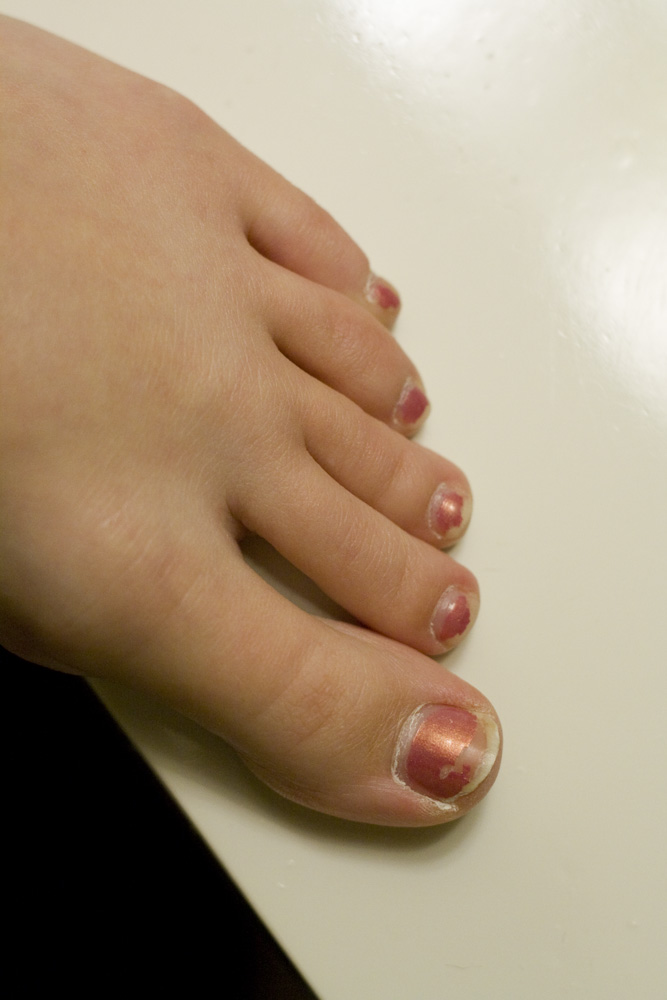
So, back to the state of my life, here are my toenails:

That's one photo you don't want to "click to enlarge."

It's time for a drastic makeover. Let's pull out the drawer o' goodies and see what we can do!

1. Soak your feet. I like to use Arbonne's Sea Salt Scrub to really soften them up. I also use a pumice stone for callouses.


2. Moisturize!

Now that my feet are nice and soft, let's work on the toenails!

4. Take the old polish off. This is one of my favorite steps, because it immediately gives me a clean slate. I often do this step very first, just to see an immediate difference. However, if you're inclined to do that, you need to still swipe your nails with polish remover  at this step to get any moisturizer off of them (which might keep the polish from sticking).

5. Clip your nails. For a French pedicure, I like to keep them a little longer than if I were just doing a solid color.

6. File your nails. I know this sounds crazy, but treat your toes just like you treat your fingers! They deserve it!

7. Gather your nail-painting supplies: White nail polish (a bright opaque white), a transparent sparkly polish (optional), clear polish, nail polish remover, and a Qtip.

8. Oh, and don't forget to put those toe foam thingies on.

9. Now, start by painting a white strip at the top of each nail. Don't worry if it ain't pretty. Take time with each toe.

10. Pour out a little polish remover into the cap. Dip your Qtip into the remover and start swirling it on the unpolished area of your toe in little circular motions, only touching the edge of the polish just enough to clean it up.

See? Much better.


11. Now paint the sparkly polish all over your toenails. This is optional, and I don't do it for fingernails, but I like the little bit of extra on my toes.

12. Top with a clear topcoat and you're done!

13. Or...you could get bored and draw stuff on your feet to call attention to your beautiful pedicure.

As a side note, I got a new purple polish that Caleb thought was hilarious. The first time he saw my toes, his question was, "What happened??" And I replied with "Mama painted her toes purple!" Every time he saw my toes, he asked the same question and I gave the same answer.

One day, we were at a restaurant and Caleb was peering under the table. He pointed and said, "Tuss...pahpo" with a little grin on his face. I had no clue what he was telling me, and after the third attempt, he looked a little dejected that his joke was not coming across as he would have liked. I kept trying to find something under the table that could give me a hint, but all that was under there were our feet. And finally I figured it out: Toes...Purple! My little man was sharing his first inside joke with me. We had a good laugh over it, and I've decided that I'll be painting my toes purple next time, just to see what Caleb says.